Why Schutzhund?

Laura VanArendonk Baugh's picture
Filed in - Schutzhund

I was asked recently, "Why do you train in bitework? I think that is a kind of weird sport, but same can be said of my love of freestyle! I'd love to read a blog on why this sport? why schutzhund?"

Fair question, and here's my answer.

Schutzhund originated as a breeding suitability test. A dog who could not do the work was not considered fit for breeding. Later, it became a sport, but even now for specific breeds in many countries, the offspring of a dog without a Schutzhund title can not be registered. I think this is a good idea; it standardizes temperament and structure within the breed and ensures continued working ability for a working breed.

In this country, Schutzhund is merely a sport, but it's still an important one. It is an advanced partnership with the dog, true teamwork (or it should be!). Rather than a mere few minutes of performance, it is a triathalon for dogs. Though known for its protection work, Schutzhund consists of three phases, Tracking, Obedience and Protection. Dogs must qualify in all three phases. It's like Michelin Tire said: "Power is nothing without control."

I like the Schutzhund obedience style a lot; it emphasizes enthusiasm and willingness as well as precision. Check out these videos of obedience and protection by a Doberman completing a Schutzhund III routine. Tell me that's not exciting! (Sabine Wiedemeyer handling Lennox von Aurachgrund, taking 2nd place in 2006 Deutschen Meisterschaft [German all-breed nationals] with 100-98-95 [100 points tracking, 98 points obedience, 95 points protection, out of a perfect 300])

Because Schutzhund expects -- requires -- the dog to be in a state of extreme arousal, obedience and control are far more necessary and more highly trained than in most dog venues. The dog must be able to hear and respond to its handler when in full fighting drive. This requires not only good training but also a good dog, one with proper genetic temperament. That's what makes the sport an excellent "character test" for dogs.

Many people understand that Schutzhund is a worthy dog sport, but I've also been criticized publicly and privately for participating in this sport. I find that frankly ridiculous. Let me address a few of the more common concerns here. :-)

  • "YOU'RE TEACHING THE DOG TO BITE PEOPLE." -- Um, no. :-) First of all, any dog person should know that all dogs can and will bite with provocation; heck, *I* will bite in the right circumstances! But more importantly, biting is just a behavior, and a Schutzhund dog will, like any trained dog, learn stimulus control. A cue begins and ends the bite, just as a cue begins and ends the down. And there are a host of very specific cues for the bite -- it's not just a free for all! If you've ever played a game of tug with a dog, you've done a miniature version of Schutzhund protection work.
  • "YOU'RE TEACHING THE DOG TO BITE PEOPLE IN SNOWSUITS." -- This accusation had to be a personal favorite of mine. I have video of us working this winter, in which my helper is wearing tan Carhartt coveralls and in which I am wearing identical tan Carhartt coveralls. Amazingly enough, the dog went to the right person when cued. :-) Sheesh.
  • "YOU'RE ABUSIVE TO THE DOGS/YOU THREATEN THE DOGS TO MAKE THEM BITE OUT OF FEAR." -- No. Schutzhund training starts as young as 8 weeks (younger, if the litter is born to a Schutzhund breeder), and all initial training is done as play. Only after the behaviors are well-started does the dog see aggression/threat from the helper, and then it is raised in small doses so as not to overwhelm the dog; the dog must always believe that he can "win" over the helper. Good Schutzhund trainers do not hurt or frighten dogs into biting. (Note: obviously there are always a few freaks in any sport, and Schutzhund can attract a few "macho" morons. Just as there are idjits who will put a shock collar on a dog to teach it an agility dogwalk, there are a few idjits who will try stupid things in bitework. This is no more correct or representative of the field as a whole than the electric collar is for agility.)
  • "THE DOGS DON'T ENJOY IT." -- Please, just come watch Laev in action. She lives for this.
  • "YOU CAN'T TRAIN IT POSITIVELY, SO YOU MUST BE HURTING YOUR DOGS." -- Again, please, just watch. Ask Laev if she feels abused. ;-) Yeah, there are traditional training recipes which aren't as dog-friendly, but we're certainly not bound to use them.
  • "SCHUTZHUND PEOPLE TREAT THEIR DOGS AS THINGS, NOT PETS." -- A good friend of mine came once with me to training and left, angry and disgusted, with this declaration. I was and remain honestly confused by his reaction (he never discussed it with me), as my dogs are cherished members of my family. Yes, some people in the sport use dogs as tools toward self-promotion, but that occurs in other sports as well! Laev sleeps beside my bed and Shakespeare shares my couch; they're my dogs first of all.

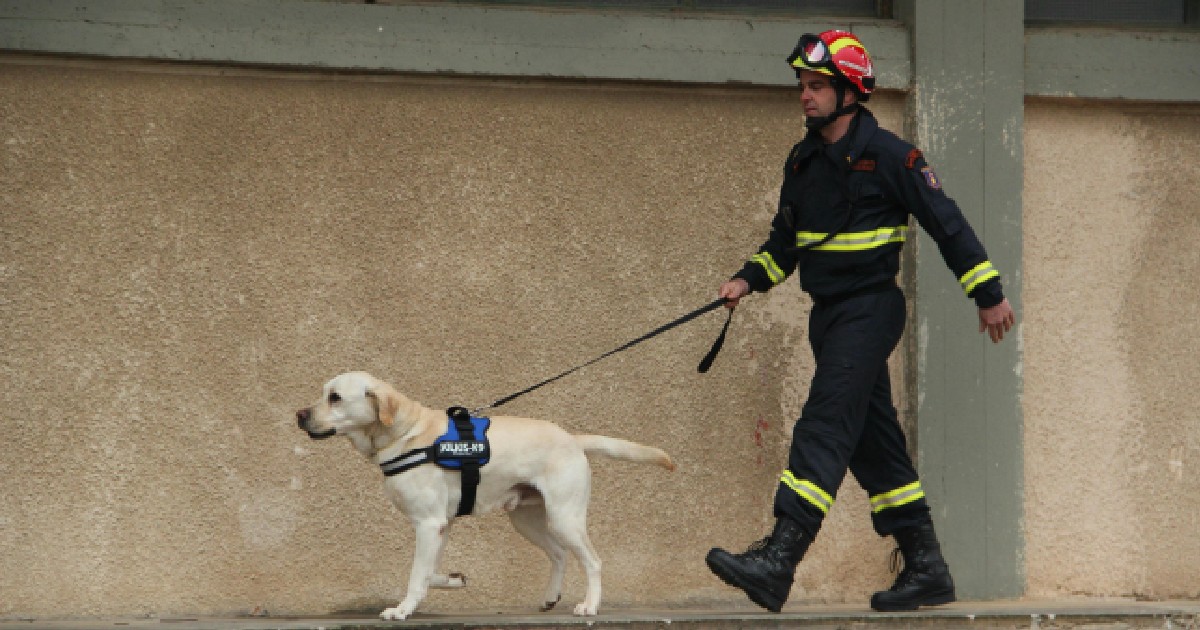
Finally, Schutzhund and similar sports/breeding suitability tests are vital for our dog community. Really! Almost all police dogs, drug dogs, accelerant/bomb detection dogs and military dogs, as well as a very high percentage of search dogs, come from Schutzhund breeders and Schutzhund lines. Why? Because it still works as a breeding suitability test, and dogs from these lines are more likely to have the correct temperament and physical structure to do the work, saving thousands of dollars in "wash-outs" from untested lines.

Similarly, Schutzhund and similar training preserves the breeds; if a Doberman was designed as a protection dog, it had better be able to work as a protection dog, or it's not a Doberman, no matter what its papers say. Max von Stephanitz developed Schutzhund as a breeding suitability test for the German Shepherd Dog; if all GSDs were expected to be able to pass such a test now, we wouldn't see such widespread reactivity and fear-aggression in the breed, or such poor hips.

Finally, Schutzhund offers excellent training and physical/mental outlet for the dogs. The socialization afforded by a good Schutzhund club is superb, and the Schutzhund dog gets far more physical exercise, mental stimulation and sheer fun than most pets!

So that's why we do what we do -- it's fun, first of all, and it's a worthy venue, second. And of course we do other sports as well; Laev has a couple of entry level titles so far elsewhere. And at those other venues, she is mannerly, safe, and a good breed ambassador. :-)

Marti Wood's picture

hi

And may i ask how many sch clubs you have visited jenny ?

Marti Wood's picture

Hi

Just a quick question Jenny do you beleive your st Bernard was protecting you or himself ? on the face of it, sounds like it was a defense behaviour dogs wont think about protecting their handlers in that state he stayed with you for support. As for GSD's being the breed commiting the most dog bites; i know it would be impossible to look at each situation individualy but chances are most of them bites came from nervous dogs a nervous dog will get no where in schutzhund therefore in theory shouldt be bred from to not produce pups of the same type. You stated somewhere the schutzhund will have an effect on bite inhibition, do you let your dogs play with a football or anything similar ? in sch the sleeve is the main attraction for the dog just a big tennis ball.

A very interesting discussion

It seems to me that you, Laura, has to face some of the same irrational arguments that we hear, because our dogs are used for hunts (along with hunting trials, field trials and conformation). When I was pregnant some people would ask me "what are you going to do with the dogs now?" "ermh..what? Nothing new *confused look*" "*aghast* But they are HUNTING dogs, how can you dare have them in the house when you are going to have kids?" ... Just how do one respond to that?
As you have met the argument about "you are teaching your dog to bite" So we hear the argument: "you are teaching your dogs to KILL" Erhmm...no, we are teaching them to ignore very distraction things in the enviroment to focus on cooperating with us to go out to find and carry back a bird (or other game) Just as Laev don't run around biting people in snowsuits (Gods, I loved that comment) neither does a hunting dog run around molesting everyting and everybody.

Hhm m nice to get that of the old chest. Thanks for listening
Christina and a bunch of not-killing-machine-chessies.

Laura VanArendonk Baugh's picture

oh, so familiar!

Your post made me grin -- yes, that's exactly the kind of conversation I've had and overheard!

I have a photo somewhere taken just after my release from the hospital, where I was taken to have my face closed after a bite. It's a ghastly picture; the scar has faded well with care but is still faintly visible. (Anybody need a heartily-recommended plastic surgeon?) The dog had no previous training of any kind and had not been socialized well. He was a cute, fuzzy mutt, the kind that will never be affected by BSL. He went directly up and for my face and throat, striking both. A few who attended the very first ClickerExpo might remember how I needed 1.5 hours or so to work my way through lunch because jaw movement was still difficult.

What I'm saying is, I have a rather low tolerance of biting dogs. I will *not* allow one of my dogs to endanger someone; that's why I made the hugely difficult decision to euthanize a rescue I'd taken on as a project, who graduated to being able to make correct decisions except when suddenly startled -- and I could not risk being the cause of someone else's pain when real life triumphed over management. I make darned sure that my dogs aren't a danger and that I don't inadvertently enable others to be.

I'm glad you gave up neither the dogs nor the kids :-) but found a way to be a family together! Amazing what proper training can do, huh? ;-)

Laura &

  • FO U-CD ARCH Shakespeare To Go CD CGC BH WAC RL1-CL RL1X RN ATT RL3 CD-H
  • Ascomannis Laevatein YTT RL1 CD-H (www.clickertraining.com/blog/179)
  • Inky (couch dog!)
Jenny Ruth Yasi's picture

http://www.leerburg.com/kidb

http://www.leerburg.com/kidbites.htm

Check out this website. Great illustration of what can go wrong when someone has a glamorous fantasy about how cool it might be to keep a guard dog.

I never worry about responsible trainers in a responsible training program. What I worried about here is the sort of glamorous misunderstanding that schutzhund might inadvertently culivate among people indulging a fantasy, who buy a protection-bred dog, and teach it to bite, but who don't get much further in training than that. I think Laura's responses, and yours too, were directed towards concerns of your own, your worries that responsible trainers get unfairly blamed for the behaviors of irresponsible dog owners. That is a fair concern, but I wasn't doing that. I blame people's fantasies and misunderstandings about protection dogs for dog bites.

Laura VanArendonk Baugh's picture

Quick answers:

I'm about to go out the door for a lesson, but here's an off-the-cuff response....

>> I see you use the TDI initials in your signature, so you must have a lot of training going on! <<

Yep! Shakespeare absolutely knows the difference between Schutzhund protection work and therapy work; his whole demeanor is different. (His therapy work is infrequent but is commonly mentally and physically handicapped children.) There are a lot of cues (environmental, too!) in his repertoire.

He has, however, stepped forward in real life to protect me. Again, he's well-socialized and he recognizes appropriate cues.

>> Are schuzhund dogs still bite inhibited? <<

Like any other dog, it depends on whether the owner/handler trained for bite inhibition. :-) I play finger/mouth games with Shakespeare all the time. I don't as much with Laev, but for her comfort, not mine; she has missed the toy and gotten my hand exactly once in her life, and she released before I could even say "ouch."

>> I wonder if there are statistics regarding unplanned dog bites in schuzhund breeds? <<

As of the last I saw reported, there is *NO* record of an inappropriate bite from a Schutzhund 3 (highest level) titled dog in this country. That's probably partly due to owner responsibility (Schutzhund 3 owners don't let their dogs run loose) as well as better training and control overall.

>> Could it be that some schuzhund dogs don't really understand that when they bite a person it hurts? Maybe they see it as a game, and they could be confused if they got loose and ran to play with kids on a playground? I think those sorts of questions are what most people worry and wonder about... <<

They certainly see it as a game! But again, look at the cues, both verbal and environmental. One exercise we've done at my club is sending a dog through a crowd of other humans to the helper. The dogs know clearly who is dressed for the fight, who is cuing them to come and fight, and who is willing to play -- or not.

As a very young dog, Laev broke a down and ran to the helper excitedly. He just stood still, and she bounced up on him and then sat before him, giving him a dirty look and a sharp bark which plainly said, "Hey, why aren't you ready for me?" I called her back, he put on the sleeve, and she was sent for a bite. No one worried about her, because she wasn't getting the complete cue to bite.

More later, if desired -- but I gotta run!

Laura &

  • FO U-CD ARCH Shakespeare To Go CD CGC BH WAC TDI RL1-CL RL1X RN ATT RL3 CD-H
  • Ascomannis Laevatein YTT RL1 CD-H (www.clickertraining.com/blog/179)
  • Inky (couch dog!)
Jenny Ruth Yasi's picture

Schutzhund hunds

Then the problem might be with people who start training in a shutzhund, but don't achieve level three, who maybe burn out or get impatient at level 1 or 2, or discover their dog's temperment isn't right for the sport? Getting reinforced and encouraged for biting has got to have a negative effect on bite inhibition.

It looks really interesting fun fantastic sport if you have excellent trainers who really know what they are doing, and also excellent handlers who don't abuse their dogs and who properly manage and handle their dogs, and if you have dogs whose temperment is strong and steady so that they can't be provoked into biting unless they are cued to do so. But those are a lot of things that could go wrong, with a lot at stake. I wonder, how do you screen trainers in this sport? You know any real clicker trainers in schutzhund?

You wrote >>He has, however, stepped forward in real life to protect me. Again, he's well-socialized and he recognizes appropriate cues.<< I'd love to hear this story!

The issue of using dogs for protection is interesting. When I was 17-25 years old, I had a St. Bernard, and I think part of the reason I loved him so much was because nobody ever hassled me when I was with that dog! I used to dispatch emergency services, police/fire/ambulance, working crazy shifts. When I was about 20 years old, after a double night shift I fell asleep on a beach, leaving my under-trained handsome smooth-coated St. Bernard dog loose, figuring he'd just snooze or explore nearby(Sampson was so easy to live with!) I woke up to my normally mellow dog raging, barking, prancing in a furious circle around me! I was like "huh? duh?" and looked up to see these three guys walking towards me, carrying shovels on their shoulders! My dog was telling them NO! He wouldn't allow them to come anywhere near me! I called Sampson, tried to tell him what I thought, that these guys were okay, but weirdly he wouldn't let me touch him, just insisted on prancing, dancing and ROARING! It's the only time in my whole life I've ever seen that behavior, it was something to behold! Wow! Scary looking, but he never physically aggressed, he just clearly THREATENED them, and wouldn't let them come one-half step closer! The men were forced to make this huge detour -- they were only trying to go work on the cranberry bog dike that was just on the other side of the beach!

Sampson had initiated that behavior while I was sleeping, with no training, no cue, no threatening life experiences, no nothing. Just, thinking for himself (and he disagreed with my opinion about the situation, too!). I loved that dog! Other than that one memorable incident, and once where a drummer in my band harassed him and got exactly what he deserved, that dog was responsive, friendly and fair to the world, totally reliable and trustworthy, the perfect dog for the person I was and the life I led at that time! I had a pet bird and a pet bunny rabbit who used to enjoy chewing on Sampson's toenails! (whereas my young dog now would have eaten them for lunch!)I loved that Sampson's idea of protecting me involved holding a threat at bay, rather than going out and actually initiating an attack. So much about aggression, and any behavior really, does seem to depend a lot on genetics...

Laura VanArendonk Baugh's picture

>> Then the problem might

>> Then the problem might be with people who start training in a shutzhund, but don't achieve level three, who maybe burn out or get impatient at level 1 or 2, or discover their dog's temperment isn't right for the sport? <<

I'm sorry, I must have missed something -- what documented "problem" are we discussing?

Again, the only statistics I have ever seen compiled showed NO bites from Schutzhund 3 dogs. As far as I know, there have never been statistics gathered for dogs with 1 or 2 titles. I don't see a "problem" to have been potentially caused by incomplete training. Could you provide your data to support this biting problem in dogs with Schutzhund experience?

Dogs with Schutzhund 1 titles (who have already passed the entry level temperament/obedience test before being permitted to trial for their 1) are also required to be called away from the helper, to out on command, etc. There's control work at all levels; the stated purpose of the sport is to demonstrate working ability and control under stress. :-)

It's generally considered that one will need about two years of training 2-3 times per week with a club and more often at home before being ready to trial for the 1.

>> Getting reinforced and encouraged for biting has got to have a negative effect on bite inhibition. <<

I'm not sure what you want to hear, since obviously what I said before didn't communicate. Let me repeat -- I play finger/mouth games with Shakespeare all the time. I still have all my fingers. Laev is incredibly cautious about my hands. Tonight Shakespeare and I were playing tug with a piece of paper in a sheet protector; it's slightly wrinkled but otherwise unharmed. I'm not sure what kind of bite inhibition you want, but if it's pressure control, I'd say we have it.

Let me try it this way -- I have been a fencer, and I currently am involved in martial arts. I know how to move aggressively and how to hit people. That doesn't make me more likely to suddenly and unexpectedly attack someone on the street, nor does it make me more likely to damage my brother-in-law when we give each other our traditional elbow nudges of greeting. (We're neither one into hugging.) It means that, should the environment *cue* a particular behavior (a fencing match), I can respond appropriately. It means that I may have more confidence and clear thinking in a stressful situation (my physical safety is threatened) because I know an established pattern of behavior. But I'm not likely to become a serial killer or a child abuser simply because I'm involved in the sport of fencing or the art of taijutsu. I still have control over my behavior.

>> It looks really interesting fun fantastic sport if you have excellent trainers who really know what they are doing, and also excellent handlers who don't abuse their dogs and who properly manage and handle their dogs, and if you have dogs whose temperment is strong and steady so that they can't be provoked into biting unless they are cued to do so. <<

It is! It's great fun. I'm glad you recognize that. And isn't it great that we have testing programs which can produce dogs with strong and steady temperaments?

And what you say above is exactly true of agility, or freestyle, or....

>> But those are a lot of things that could go wrong, with a lot at stake. <<

Offhand, I'd say there are a lot of things that could go wrong in a lot of sports. My husband broke his neck playing football, for example. I don't feel myself or my dogs any more at risk in Schutzhund than anywhere else. Actually, there are times when I feel much more threatened at AKC events, where crowds of people cruise past wholly unattentive to their rude dogs on long leashes.... A dog scuffle broke out just behind Laev's Novice stay line a couple of weeks ago, and no one blamed the sport.

>> I wonder, how do you screen trainers in this sport? <<

Good clubs definitely screen new members, yes. And you seem to be focusing solely on the protection work; don't forget that this is a triathlon -- there are THREE phases which members must train. Macho yahoos don't tend to make it through tracking very often, and that in itself weeds out many of the "dog mobsters." :-)

>> You know any real clicker trainers in schutzhund? <<

That depends upon your personal definition of "clicker trainer." Perhaps you think I'm out because I did, for example, keep an Easy Walk body harness in the car for a year or so, so that when Laev's excitement got the better of her young brain I could manage instead of training through it if I were on a time constraint. I publicly admitted to an instance of P+ a few posts ago, so I can see why you exclude me from your personal list of clicker trainers, but without a clear definition, I can't tell you who else is still in.

As far as our own Schutzhund training, we use the clicker (or another marker, if not the mechanical clicker) in every session. Laev's obedience is 100% clicker trained. Laev's hold and bark (one of the toughest exercises, and one traditionally trained with a lot of aversives) is 100% clicker trained. (See http://www.clickertraining.com/node/722 for details.) I don't carry a clicker in tracking, but it's trained wholly inducively. Laev is released with a click to go to the helper for the bite (and please, don't even try the archaic protest that I'll teach the dog to attack people upon hearing a click; it hasn't happened that she hears a click and steals the nearest hoagie, either, even though sometimes I use a food reinforcer :-) ).

Laura wrote:
>> He has, however, stepped forward in real life to protect me. Again, he's well-socialized and he recognizes appropriate cues. <<
Yasi wrote:
>> I'd love to hear this story! <<

It's probably not as interesting as you think, as it features a calm, thoughtful dog who exhibited only just enough threat to make the two bad guys go away, never escalating past a throaty growl and rather pointed body language. The instant the threat retreated, Shakespeare stood down and went back to civilian dog duty, and when we had to pass the bad guys again on the way out, he heeded my signal to ignore them as they were staying safely away. (He was off-leash during most of this.) There were no cues to bite, no requirement to do so, and so why would he?

This is the same dog who has done "Annie' twice, loose with 90 kids in one production and 30+ in another. I don't worry about him going off inappropriately.

>> My dog was telling them NO! He wouldn't allow them to come anywhere near me! I called Sampson, tried to tell him what I thought, that these guys were okay, but weirdly he wouldn't let me touch him, just insisted on prancing, dancing and ROARING! <<

Interesting! Nice that he wanted to protect you. What do you think was the stimulus/cue for him to respond -- what was the threat? Why do you think he would not calm when you tried to direct him?

>> Scary looking, but he never physically aggressed, he just clearly THREATENED them, and wouldn't let them come one-half step closer! <<

I have to disagree with you here -- barking and roaring is clearly aggression! He may not have made physical contact, but I think anyone would categorize that kind of behavior as aggressive. Sometimes it can be appropriate aggression, but it's still aggression.

>> The men were forced to make this huge detour -- they were only trying to go work on the cranberry bog dike that was just on the other side of the beach! <<

And so you can see the advantage of a dog trained to recognize a specific threat stimulus (which, in Schutzhund, is highly stylized), and also to stand down on cue.

>> that dog was responsive, friendly and fair to the world, totally reliable and trustworthy, the perfect dog for the person I was and the life I led at that time! <<

Dogs like that spoil us for life. :-) I've had those, too -- Shakespeare is one now, almost too perfect and too easy! Sampson sounds like a really nice guy.

>> I loved that Sampson's idea of protecting me involved holding a threat at bay, rather than going out and actually initiating an attack. <<

Exactly what I said about Shakespeare -- he had the knowledge and the confidence to do exactly what was required and not a jot more.

>> So much about aggression, and any behavior really, does seem to depend a lot on genetics... <<

I've hit this soapbox before :-) but that is exactly why we need fit-for-breeding tests -- stress-testing both physically and mentally -- to make sure our programs are producing the best possible dogs.

Laura &

  • FO U-CD ARCH Shakespeare To Go CD CGC BH WAC RL1-CL RL1X RN ATT RL3 CD-H
  • Ascomannis Laevatein YTT RL1 CD-H (www.clickertraining.com/blog/179)
  • Inky (couch dog!)
Jenny Ruth Yasi's picture

Hey Laura

Whoa that's a long post. You sound defensive and you don't need to be. My comment about "the problem" is really reference to the statistic that German Shepherds are responsible for most dog bites in the country. I know not all shepherds are schutzhund dogs, but there is a relationship between the breed and the sport. You answered my concerns (concern being another word for "question, and my questions are common concerns, you know that), by saying that dogs must pass temperment tests to trial at level one. Oh, good to know! Hope it's a good test! The area of the body that I think a dog could get confused about would be the sleeve, since they practice and are conditioned to bite down very hard on that.

The reason Sampson, my dog from about 28 years ago, was reacting defensively was because I was sleeping when men with shovels resting blade up over their shoulders arrived and began walking directly towards me. When I first woke up and saw them approaching the men were a startling sight. The reason I don't define Sampson's behavior as aggressive: he was off-leash and COULD have approached them, but he didn't. That's different than a dog lunging on a leash, who (if you dropped the leash) would charge. Sampson didn't charge. He paced in a circle around me, roaring. He DID calm down after the men made their detour around me, mostly because I picked up my towel ASAP and skedaddled. It WAS creepy, as I was the only other person on the beach, I was a very young woman and we were in a very remote location.

The reason he didn't calm down at first is because dogs are cognitive beings. They have their opinion. I was very young, the dog felt I was threatened. He loved me madly. He wasn't going to take a chance. It worked out fine. I've lived my story always assuming the worker guys were innocent, you are assuming the scary guys you saw were bad guys. But who knows? Maybe we are both wrong. My dog, as I said, was totally untrained, but he was very well adapted to life with me, he could sit and down and hang out without a leash and communicate with me, so I use him as an example of the natural reaction of a very well-socialized dog (he was with me through music school, and used to hang around off-leash on campus, just lay there off-leash under a tree and wait for me to get out of class. The University made a special exception for him, they tolerated him because everyone loved him! He was the prettiest St. Bernard I've ever seen! I miss that dog!!). I don't think we need to train our dogs to be guard dogs to get them to protect us when we really need it. My point is that a well-socialized dog is naturally likely to appropriately act to protect those he loves. It's a natural reaction. If you're not a cop, I don't think it's necessary to teach a dog to go look for and pull down the bad guy in order to wind up with an effective protection dog, but different strokes for different folks!

I think one of the problems with using punishment to train dogs (not saying YOU do it!) is that it inhibits canine ability to communicate. I know SOME schutzhund people do use punishment, and wherever there's a lot of emphasis on control and fight drives there will be those who train in a "handler dominant" fashion. I love that my dogs are able to think for themselves as well as listen to me. I appreciate their opinions. I love that they express themselves. I don't need to dominate my dogs. Read my blog about barking on cue, and how I tried to tell Dandylion he didn't need to keep barking, but since I've never punished him for barking, he was able to persist and tell me something I really needed to know. I like that. Tigerlily did the same thing, because she wasn't sure that I clearly understood that there was a man hiding in the woods. Again, I didn't train those behaviors. My little fluff heads offered them on their own initiative.

Thanks for the time to answer the questions, interesting sport, sounds like fun! Best wishes with it!

Laura VanArendonk Baugh's picture

Late, late, late night reply

>> Whoa that's a long post. You sound defensive and you don't need to be. <<

My apologies -- some of your wording ("the problem") implied an existing documented condition, which I felt was unwarranted and I really wanted to demonstrate there just isn't evidence for such a problem.

>> My comment about "the problem" is really reference to the statistic that German Shepherds are responsible for most dog bites in the country. I know not all shepherds are schutzhund dogs, but there is a relationship between the breed and the sport. <<

There is definitely a relationship between the breed and the sport; the sport was designed not as a sport (it became that later), but as a test to keep the breed safe and healthy. :-) But I don't think even the broadest statistical brush could connect the sport to a high incidence of GSD bites in the US.

There are over 40,000 German Shepherds registered each year with the AKC. There are more which are never registered. There are approximately 3,000 active Schutzhund club members in the country. Even if we are generous and allow that each handler has two dogs, that still does not represent two new dogs per year! but possibly only .2 of a dog per year. Keeping up with the math? :-) We're now at perhaps 1.5% of the GSD population (known to the AKC, not including unregistered dogs) being involved in Schutzhund. But wait -- those 3,000 handlers represent *all* breeds, not just GSDs. (My club alone, which is very small, includes GSDs, Dobes, a mixed breed, a Great Dane, mastiffs....) So that 1.5% is going to shrink even smaller.

It's late, and my math might be imperfect, but even so -- given what I quoted earlier about the lack of any documented report of an inappropriate bite from a SchH3 dog, it seems that Schutzhund is not going to make a statistical dent in the dog bites here. :-)

>> The reason I don't define Sampson's behavior as aggressive: he was off-leash and COULD have approached them, but he didn't. That's different than a dog lunging on a leash, who (if you dropped the leash) would charge. <<

(Unless, of course, the leash is allowing a kind of barrier aggression, which disappears the moment the "safety" of the leash restraint is removed...! That's precisely why we loosen leashes on reactive dogs in pet training and use a leash or long line with under-confident dogs in bitework!)

By that definition, then, Shakespeare's behavior toward the two Very Creepy Bad Guys was not aggressive, either; he was offleash, but he simply placed himself in the bottleneck and growled, a canid Spartan. :-) He quietly informed them that he owned the turf leading toward me, and they opted to abandon the issue. /grin/

>> If you're not a cop, I don't think it's necessary to teach a dog to go look for and pull down the bad guy in order to wind up with an effective protection dog, but different strokes for different folks! <<

I partially agree with the above, but it has nothing to do with Schutzhund. :-)

Remember what I said about Schutzhund threats being stylized? A Schutzhund dog is *NOT* a protection dog. No knowledgeable Schutzhund handler will pretend that is so, and any trainer advertising Schutzhund training as a means to a protection dog is probably half snake-oil salesman (and, in my observation, suspect in training techniques as well).

Nor is a Schutzhund dog a police dog -- although many police dogs are Schutzhund dogs, and many Schutzhund dogs convert easily to police dogs. :-) They also convert well to SAR, bomb detection, etc.; the basic skills are quite similar. No, my club's dual Schutzhund-Search dogs have never bitten a victim!

At the risk of stepping on some martial arts toes :-) Schutzhund is more like tae kwan do, best suited for ritualized matches, while police work or protection training is like taijutsu or other arts which have no competitions or tournaments. One is designed for a point system in a predictable environment, the other is designed for real life. :-) But one may help you prepare for the other, if done properly.

>> I know SOME schutzhund people do use punishment, and wherever there's a lot of emphasis on control and fight drives there will be those who train in a "handler dominant" fashion. <<

Sure. But that's by no means limited to Schutzhund! There are bad handlers and poor trainers in all sports and all venues. Rise above them. I will not show beneath a couple of local AKC obedience judges because I've seen them kick their dogs in practice. I've seen competitors in APDT Rally, possibly the most dog-friendly of venues, using training techniques which I wouldn't touch. That doesn't make AKC Obedience or APDT Rally bad venues; it means that *we* have to set better examples and not be stigmatized along with those people.

Laura &

  • FO U-CD ARCH Shakespeare To Go CD CGC BH WAC RL1-CL RL1X RN ATT RL3 CD-H
  • Ascomannis Laevatein YTT RL1 CD-H (www.clickertraining.com/blog/179)
  • Inky (couch dog!)
Jenny Ruth Yasi's picture

the breed thing

Yeah, all well and good, but I thought you said the reason people train in Schutzhund is because that title (whatever title, something or other) is required to breed their dogs. So, the titled dogs have puppies, and likely many of those puppies aren't ultimately trained in the sport. When you look at German Shepherd dogs, some rather significant percentage of them come from Schutzhund lines, a much higher percentage than those that actually wind up training in the sport. So, the influence of the sport on breeding choice is what I'm really asking about. It *seems like* if schutzhund was such a great way of screening breeding dogs, that the German Shepherd breed of dogs wouldn't happen to become the breed most likely to bite. But I love German Shepherds, don't get me wrong! And in general I dislike the AKC and breed clubs because it seems to me like "pedigree" breed practices ruin dogs, I often think, poor collies! Look what they've done to collies and sharpeis, and boxers and shepherds! ahk, I'm opposed to extremism in any form, even breeding practices! Give me that open gene pool! But anyway, that's a different conversation. There are good dogs and troubled dogs.

You never say how you know that your two creepy dudes were bad guys? What was the cue that provoked Shakespeare to growl?

Laura VanArendonk Baugh's picture

>> Yeah, all well and good,

>> Yeah, all well and good, but I thought you said the reason people train in Schutzhund is because that title (whatever title, something or other) is required to breed their dogs. <<

Not quite. I have no present plans to breed, and I train in the sport.... Some of us non-breeders do it because it's enormous fun for both ends of the leash. :-)

I said that Schutzhund was developed as a breeding test, but later became a sport. While titled Schutzhund dogs have a good chance of being good breeding stock, most Schutzhund dogs will NOT be bred, just as most obedience or agility dogs will not be bred.

I also reported that it is required elsewhere in the world that dogs be titled to be bred. I said I thought it was a good idea, because it helped to stabilize temperament and physical structure. That's why it was developed in the first place! :-)

>> So, the titled dogs have puppies, and likely many of those puppies aren't ultimately trained in the sport. <<

I would disagree with you. Most of the Schutzhund breeders I know have an interview process with potential buyers and deposits/waiting lists before the puppies ever hit the ground, often before they're even bred. Many handlers import a puppy because the supply here is limited. Most puppies from working lines (truly working bred, not just a working ancestor or two) go to working homes; people who want "just a pet" can find those far more easily (greater supply) without the additional effort of research and the price of a qualified puppy.

Laev's breeder's contract included a clause that the puppy *would* be trained in Schutzhund. No training, no puppy.

But there are imperfect breeders out there and even bad breeders. So we'll say a few get away. But even if Schutzhund-bred puppies *were* going helter-skelter all over the country, even if every single puppy from Schutzhund parents never received its own training, remember that you're still looking at the offspring of 1% of the GSD population -- hardly a statistical majority in the GSD puppy market.

>> When you look at German Shepherd dogs, some rather significant percentage of them come from Schutzhund lines, a much higher percentage than those that actually wind up training in the sport. <<

I doubt your statement that many or most GSDs come from Schutzhund lines. I think you've encountered a mere marketing term! Yeah, sure, a lot of puppy ads in a certain niche might say that -- but research will reveal that one great-grandsire had a title! Maybe even three distant titles in the pedigree! On the other hand, Laev has something like 35 relevant titles in her immediate pedigree, so you can see the difference in concentration.

It's a simple mathematical fact -- 2,000 or so Schutzhund GSDs cannot produce 40,000+ puppies per year. Somebody is breeding untitled, untested dogs, and it's a little unfair to blame the Schutzhund dogs for the unethical breeders' product. :-)

>> It *seems like* if schutzhund was such a great way of screening breeding dogs, that the German Shepherd breed of dogs wouldn't happen to become the breed most likely to bite. <<

But people aren't using Schutzhund as a screen for breeding dogs, or we wouldn't have ~2,000 GSDs in Schutzhund and 40,000+ puppies a year! That would be non-stop litters of 20, twice a year, from every single bitch -- if every single one were breeding twice a year instead of training or working or competing or just not being a mother!

Now remember what I said about needing several years of training to title.... You can't get there if you're breeding often. These 40,000 dogs aren't coming from Schutzhund parents.

Let's look at another GSD factor, hips. They're a breed known for frequent hip problems. Now, it *seems like* if Schutzhund were such a great way of screening physical structure (Schutzhund requires clean 39" vertical jumps carrying a 1.5 lb dumbbell as well as scaling a steep 6' wall), we wouldn't see so much genetic hip dysplasia. And indeed, in working lines there's *much less* hip trouble! My helper's own dog is 12 years old and still training -- was still actively trialing at 11 years old, wall-scaling and bitework and all! But you can't get the benefits of testing unless you're testing.

(Consider, too, that the high ratio of GSD bites correlates with the GSD being one of the most popular breeds in the US. The odds are greater, even without taking training into account.)

Your statement also seems to contradict your earlier concern re bite inhibition, where you said encouraging to bite hard on the sleeve would cause problems.... Now, it seems, you're saying it's not the training, but breeding. But hey, I'll be the very first in line to protest the breeding of poor temperament! I feel very strongly about breeding without documented temperament testing.

I appreciate your concern for the safety of children and others; it's obvious you have worried about this quite a bit! I think the risk posed by Schutzhund is rather minimal. I am a staunch opponent of BSL; good temperament and good image are important to me! I wouldn't endanger my dogs by allowing them to be a risk to someone else. And I just can't see how a dog which must demonstrate control under stress is more dangerous than a dog who must rely only upon his instincts in a human world.

Okay, I *really* must move on to something else. I think we've already set a new record for comments on a single post! So no more on this. :-)

>> You never say how you know that your two creepy dudes were bad guys? What was the cue that provoked Shakespeare to growl? <<

I can't speak for Shakespeare, but I suspect that he registered the body language (predatory?) and probably scent as well (adrenaline, testosterone, etc.) He saw them first, so it wasn't a cue from me. For myself, the fact that two men tried to follow me into an empty women's restroom was a bit suspicious. :-)

Laura &

  • FO U-CD ARCH Shakespeare To Go CD CGC BH WAC RL1-CL RL1X RN ATT RL3 CD-H
  • Ascomannis Laevatein YTT RL1 CD-H (www.clickertraining.com/blog/179)
  • Inky (couch dog!)
Jenny Ruth Yasi's picture

Great post

Thanks for sharing the video clips Laura, they are great to watch! Loved it. The obedience clip really look like a freestyle performance (just add music, and let the handler rock and roll a little bit, and that's it)! I think we can all benefit from sharing the training experience that is gained in different sports, handling different breeds and temperments to perform different sorts of tasks. I had a great schuzhund dog in one of my freestyle classes recently, this dog was not physically inhibited, you might even say some of the behaviors looked pretty rude, jumping and biting eagerly to get his handler to play, jumping right up on me, but I found his confidence really fun, a refreshing change of pace from more sensitive tempermental types. It will be much faster and easier to teach Mr. Bouncy Pushy to control and focus that enthusiasm than it will be to teach a nervous poodle in the same class to relax and come out of her shell!

So, it's great to have different sports for different dogs, because while it looks like a schuzhund dog is well prepared to play agility and freestyle games, not all dogs (as you say), are right for schuzhund (especially if you have to use things like collar pops to get these behaviors). But adapting the schutzhund games, training them with click and treats, matching criteria and method with temperment, then I think any dog, any team can benefit from confidence building handling games like these. Respecting the innate temperment of the dog, and not pushing a dog beyond it's sense of safety in any sport is really important.

I train therapy dogs and volunteer pet assisted therapy through TDI, and many of the clients we interact with can sometimes behave very bizarrely, threateningly, lurching around, shrieking, even waving arms and legs threateningly, hiding. My dog is trained to respond to that sort of cue by moving behind me in those situations,to prevent further provoking those situations. My dogs learn that I handle the other dogs and humans, that's MY job. One of my teachers used to say "what do you want for the default behavior?" A default behavior is the behavior the dog is most likely to choose when the handler is not available to cue the dog. So, we do want to make sure that the default behaviors we are training in our dog will be safe behaviors for whatever situations they are faced with. I see you use the TDI initials in your signature, so you must have a lot of training going on!

So, my question is about default behaviors. Are schuzhund dogs still bite inhibited? I wonder if there are statistics regarding unplanned dog bites in schuzhund breeds? Could it be that some schuzhund dogs don't really understand that when they bite a person it hurts? Maybe they see it as a game, and they could be confused if they got loose and ran to play with kids on a playground? I think those sorts of questions are what most people worry and wonder about...